トピックス
【2026.2.16 GIR公開セミナー】Dr. Fang Zhao “AI for Water Challenges: Ocean Oxygen and Flood Mapping”
- イベント報告
- 2026.2.17
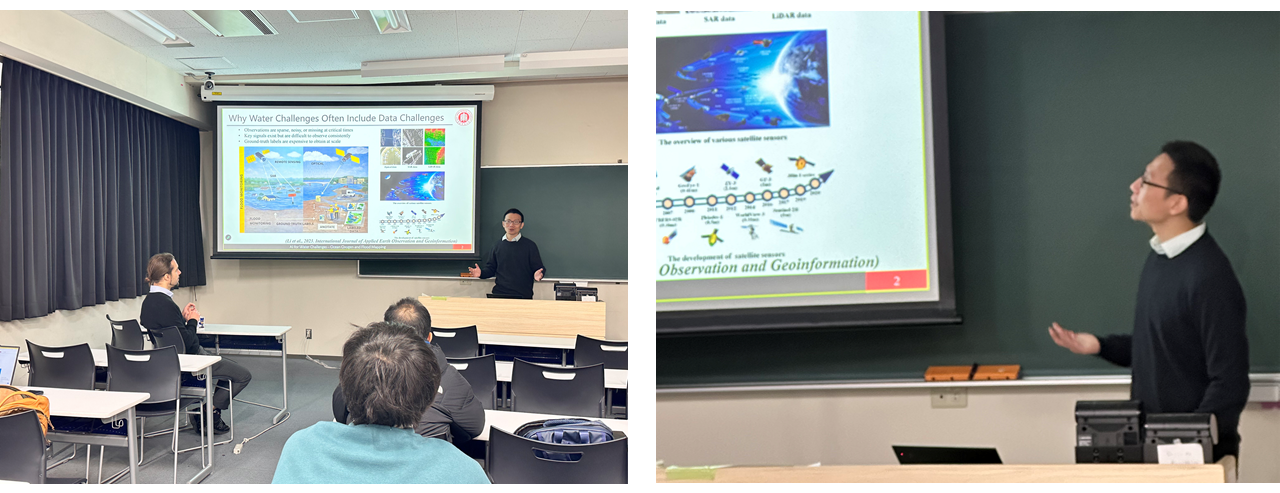
◆講演者:Dr. Fang Zhao (中国、華東師範大学、教授)
◆講演タイトル:”AI for Water Challenges: Ocean Oxygen and Flood Mapping”
◆日時:2026年2月16日(月)(10:00~12:00)
◆会場:東京農工大学 府中キャンパス 2号館2階2‐22講義室
◆言語:英語
◆開催担当者:グローバルイノベーション研究院 農学研究院 ジュリアン ブランジェ准教授 (グローバルイノベーション研究院 食料分野 ジュリアン ブランジェチーム)
◆開催案内
◆参加人数:6人
講演概要
Prof. Fang Zhao gave a talk about leveraging AI technology to address the lack of data. He first introduces essential concepts about AI and how different models can be used in different contexts (regression and classification).
The first AI application focused on ocean oxygen which has been reported to be decreasing globally with recurrent impacts documented on fishes in Australia among other locations. Existing ocean oxygen observations are unsurprisingly temporary and spatially sparces. Reanalysis data (i.e., ERA5) where used with a deep learning model generate complete 3d fields of ocean oxygen. Results showed excellent agreement between the AI generated and observations and revealed multiple hotspots of decrease and increase in ocean oxygen.
In the second AI application, Prof. Fang focused on flood prediction in the Yangtze basin. While global flood databases are emerging, they are still constrained temporarily and spatially. In this classification task, multiple AI models were used in conjunction with Sentinel-2 imagery to identify water (flooded) areas. The SegNext model architecture provided the most accurate prediction which were used to quantify agricultural damage from a major flood event in 2020.
The last AI application is also a classification task, aiming at identifying the boundary between land and water in widely different environments. Hence in this exercise the model must retain some flexibility since water and land colors, river dimension will vary drastically across locations. Most AI architectures performed very well, and differences were largely limited to the model ability to distinguish man-made structures.
In conclusion, when working with AI, it is critical to carefully prepare the input data since this step will have a greater impact on the prediction than a given AI architecture.
このページの上部へ