イベント情報
【GIR公開セミナー】Dr. Andrzej Cichocki / ポーランド科学アカデミー (ポーランド)
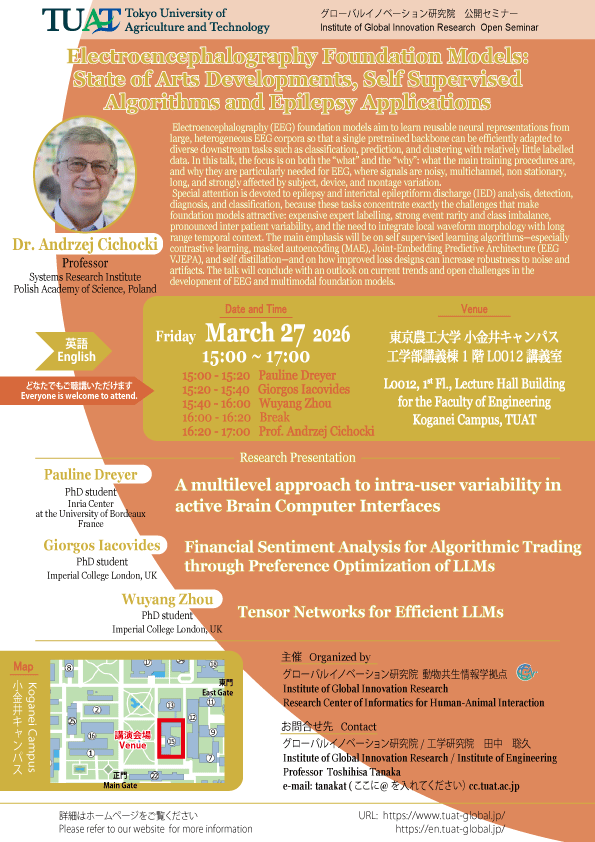
| 日時 | 2026.3.27(15:00~17:00) |
|---|---|
| 会場 | |
| 講演者 | Dr. Andrzej Cichocki |
| 所属機関 | ポーランド科学アカデミー (ポーランド) |
| 講演タイトル | "Electroencephalography Foundation Models: State of Arts Developments, Self Supervised Algorithms and Epilepsy Applications" <要旨> Electroencephalography (EEG) foundation models aim to learn reusable neural representations from large, heterogeneous EEG corpora so that a single pretrained backbone can be efficiently adapted to diverse downstream tasks such as classification, prediction, and clustering with relatively little labelled data. In this talk, the focus is on both the “what” and the “why”: what the main training procedures are, and why they are particularly needed for EEG, where signals are noisy, multichannel, non stationary, long, and strongly affected by subject, device, and montage variation. Special attention is devoted to epilepsy and interictal epileptiform discharge (IED) analysis, detection, diagnosis, and classification, because these tasks concentrate exactly the challenges that make foundation models attractive: expensive expert labelling, strong event rarity and class imbalance, pronounced inter patient variability, and the need to integrate local waveform morphology with long range temporal context. The main emphasis will be on self supervised learning algorithms—especially contrastive learning, masked autoencoding (MAE), Joint-Embedding Predictive Architecture (EEG VJEPA), and self distillation—and on how improved loss designs can increase robustness to noise and artifacts. The talk will conclude with an outlook on current trends and open challenges in the development of EEG and multimodal foundation models. |
| 言語 | 英語 |
| 対象 | どなたでも、ご参加いただけます。 |
| 主催 | グローバルイノベーション研究院 Global Research Hub "動物共生情報学拠点" |
| お問い合わせ窓口 | グローバルイノベーション研究院・工学研究院 田中 聡久 e-mail: tanakat (ここに@ を入れてください)cc.tuat.ac.jp |
| 備考 | 本セミナーは、対面型のみの開催となります。 ——————————————————————————————————————— セミナーと同時に、来日中の博士課程学生より研究発表を行います。
Pauline Dreyer (国立情報学自動制御研究所 (INRIA)・フランス) “A multilevel approach to intra-user variability in active Brain Computer Interfaces.” <要旨>
Giorgos Iacovides (インペリアル カレッジ ロンドン・英国) “Financial Sentiment Analysis for Algorithmic Trading through Preference Optimization of LLMs”
Wuyang Zhou(インペリアル カレッジ ロンドン・英国) “Tensor Networks for Efficient LLMs” ——————————————————————————————————————— プログラム
15:00 – 15:20 Pauline Dreyer |
このページの上部へ