イベント情報
【GIR公開セミナー】Dr. David Kisailus / カリフォルニア大学 アーバイン校(米国)
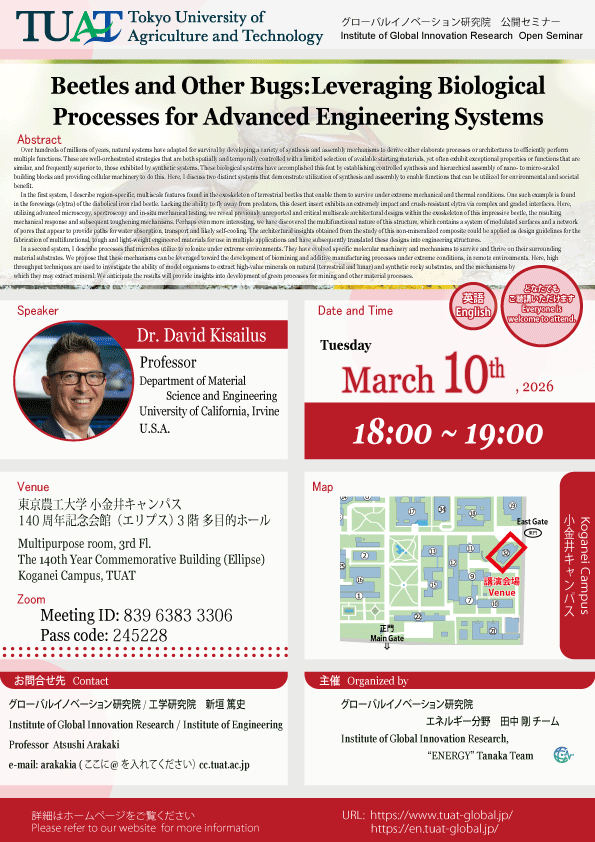
| 日時 | 2026.3.10(18:00~19:00) |
|---|---|
| 会場 |
東京農工大学 小金井キャンパス 140周年記念会館(エリプス) 3階 多目的ホール ミーティングID:839 6383 3306 パスコード:245228 |
| Google Classroom コード | gk4bl7jn |
| 講演者 | Dr. David Kisailus |
| 所属機関 | カリフォルニア大学 アーバイン校 (米国) |
| 講演タイトル | "Beetles and Other Bugs: Leveraging Biological Processes for Advanced Engineering Systems" <要旨> Over hundreds of millions of years, natural systems have adapted for survival by developing a variety of synthesis and assembly mechanisms to derive either elaborate processes or architectures to efficiently perform multiple functions. These are well-orchestrated strategies that are both spatially and temporally controlled with a limited selection of available starting materials, yet often exhibit exceptional properties or functions that are similar, and frequently superior to, those exhibited by synthetic systems. These biological systems have accomplished this feat by establishing controlled synthesis and hierarchical assembly of nano- to micro-scaled building blocks and providing cellular machinery to do this. Here, I discuss two distinct systems that demonstrate utilization of synthesis and assembly to enable functions that can be utilized for environmental and societal benefit. In the first system, I describe region-specific, multiscale features found in the exoskeleton of terrestrial beetles that enable them to survive under extreme mechanical and thermal conditions. One such example is found in the forewings (elytra) of the diabolical iron clad beetle. Lacking the ability to fly away from predators, this desert insect exhibits an extremely impact and crush-resistant elytra via complex and graded interfaces. Here, utilizing advanced microscopy, spectroscopy and in-situ mechanical testing, we reveal previously unreported and critical multiscale architectural designs within the exoskeleton of this impressive beetle, the resulting mechanical response and subsequent toughening mechanisms. Perhaps even more interesting, we have discovered the multifunctional nature of this structure, which contains a system of modulated surfaces and a network of pores that appear to provide paths for water absorption, transport and likely self-cooling. The architectural insights obtained from the study of this non-mineralized composite could be applied as design guidelines for the fabrication of multifunctional, tough and light-weight engineered materials for use in multiple applications and have subsequently translated these designs into engineering structures. In a second system, I describe processes that microbes utilize to colonize under extreme environments. They have evolved specific molecular machinery and mechanisms to survive and thrive on their surrounding material substrates. We propose that these mechanisms can be leveraged toward the development of biomining and additive manufacturing processes under extreme conditions, in remote environments. Here, high throughput techniques are used to investigate the ability of model organisms to extract high-value minerals on natural (terrestrial and lunar) and synthetic rocky substrates, and the mechanisms by which they may extract mineral. We anticipate the results will provide insights into development of green processes for mining and other material processes. |
| 言語 | 英語 |
| 対象 | どなたでも、ご参加いただけます。 |
| 主催 | グローバルイノベーション研究院 エネルギー分野 田中剛チーム |
| お問い合わせ窓口 | グローバルイノベーション研究院・工学研究院 新垣 篤史 e-mail: arakakia(ここに@ を入れてください)cc.tuat.ac.jp |
| 備考 | 本セミナーは、オンライン・対面型の同時開催となります。 |
このページの上部へ